Once Saved, Always Saved: The Toxic Root of the Dead Church
This post will dicuss whether the doctrine of "Once Saved, Always Saved" is based on Scripture or is just another deceptive pathway to hell. I ask readers who believe in this view to set aside all preconceived notions and truly examine the evidence provided in this post, especially if raised in a church that emphasized this viewpoint.
“Beware of manufacturing a God of your own: a God who is all mercy, but not just; a God who is all love, but not holy; a God who has a heaven for everybody, but a hell for none; a God who can allow good and bad to be side by side in time, but will make no distinction between good and broad in eternity. Such a God is an idol of your own, as truly an idol as any snake or crocodile in an Egyptian temple. The hands of your own fancy and sentimentality have made him. He is not the God of the Bible, and beside the God of the Bible there is no God at all.”
At the end of this post, I will include a wonderful sermon from J.C. Ryle from the 1800s, which is more relevant today than ever before. Ultimately, people have manufactured their own doctrine to make Christianity more "friendly" to the masses, and this is true of many popular doctrines in the end tiemes churches.
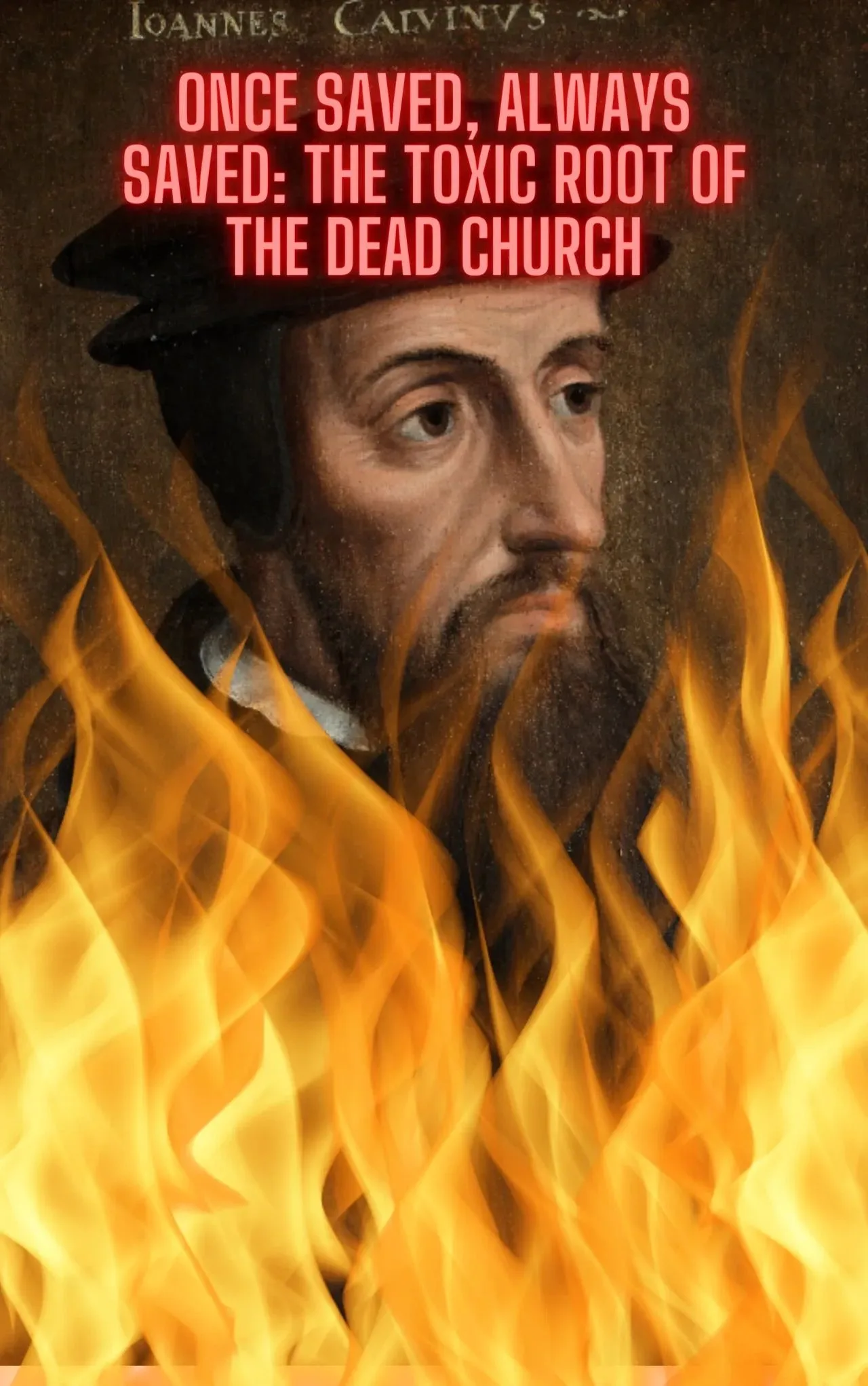
Introduction: Thesis 1 - One Can Lose Their Salvation in Christ
Can a Christian, once saved, lose his/her salvation?
This is perhaps the most important question a Christian can ask, and this is Thesis 1 of the “End Times 95 Theses by The Two Witnesses of Revelation.” In 1517, Martin Luther wrote a series of theses he presented to the corrupted church, sparking the Protestant Reformation, and in a similar way, we are presenting a new 95 theses to the modern corrupted church, with an emphasis on false doctrine, in hopes to spark a spirit of repentance and rejuvenation in these dark times.
To note, Witness 1 has already written that we are not saved by works, while I have written how faith without works is dead, and works are still an important part of faith. This post is not centered on the subject of salvation based on faith and/or works, but it will be discussed in another of the 95 theses (or however many God leads us to write).
Before I present my claims, I plead with readers to drop any preconceived notions or biases and consider everything I present here before forming a conclusion. I spent hours upon hours on this, including praying and fasting to ensure I am writing what God wants me to write. Let us not idolize any doctrine; rather, let us evaluate every doctrine presented to us and only choose the beliefs that will lead us to Heaven.
With that being said, the central question of this post is this - can one lose salvation once they are saved? The thesis of this post is that yes, one can lose their salvation even after being "saved", and before going into Scriptural analysis, let’s start with the most important argument of this post.
Only God knows who is saved, and man cannot see from God’s perspective. Therefore, the question of salvation is only in His eyes and His hands, and there will be many surprises on Judgment Day. Every man is rightful in his own eyes, but only God sees the heart. Can any man see another man’s inner heart? No. Only God. Does the Bible say that any man knows who is saved? No, only God knows who is saved. Because of this, judgment is not in our hands. Only Jesus is the judge, and only He knows who is, can be, or will be saved. There is not one human who can prove to anyone in any way 100% without a doubt they are in this moment saved. How could one prove it other than with a claim? It would be impossible because there is an invisible, spiritual seal that only God can see, and any man who claims to see it cannot prove that claim. Therefore, many who claim salvation from God’s perspective have already failed by the arrogance of trying to claim they can see from God’s eyes. None of us are God, and therefore, we can only view the status of one’s salvation through the eyes of men. So, as Paul said, we should work out our salvation on a daily basis, with fear and trembling. This verse implies that salvation is in flux - that it is, perhaps, a variable state of being. At the conclusion of this post, there will be a response to the question, “Am I saved?” with help for those who are fearful. For now, ask yourself, “Can I see the salvation of myself or others through God’s eyes?” The answer is no - we are not God.
Of course, this is just the beginning of the claim that one can lose their salvation. This post is not one of hopelessness or fear. It is one of the truths that will help motivate readers to do the work God wants them to do. The OSAS doctrine has created a "culture of complacency" in the church, and we will explore this idea later in this post. Freeing yourself from this doctrine will help you be who God wants you to be.
This post will go into the history of the “eternal security doctrine”, examine key scriptural viewpoints, and finally, go into logical and philosophical arguments against this dangerous doctrine. This doctrine, in fact, is so dangerous that it is the rotten core of the modern, dead church, and hence, Thesis 1 of the 95 theses, so let's begin with its history.
The History of “Eternal Security”
When looking into doctrine, it is often important to find out where a specific doctrine emerged and why. In other words, in order to understand a doctrine, one must first understand its emergence in the church itself. Before going deeper into the points against “once saved, always saved” (OSAS) doctrine, let’s figure out where it first appeared on the Christian scene.
The OSAS doctrine does not appear to be part of the primitive church. Justin Martyr, one of the early founders of Christianity, wrote,
- But I believe that even those, who have been persuaded . . . to observe the legal dispensation along with their confession of God in Christ, shall probably be saved. And I hold, further, that such as have confessed and known this man to be Christ, yet who have gone back from some cause to the legal dispensation, and have denied that this man is Christ, and have not repented before death, shall by no means be saved. Further, I hold that those of the seed of Abraham who live according to the law, and do not believe in this Christ before death, shall likewise not be saved . . . – Justin Martyr, Dialogue Of Justin 47
In fact, if one looks to the early church, there is little to no evidence of “eternal security” or OSAS.
Unfortunately, Protestants and Wikipedia have been dishonest about attributing this doctrine to Augustine. Augustine explicitly said salvation could be lost, and others have loosely interpreted his work to fit in with their man-made doctrines:
- One of the books of St, Augustine entitled Treaties on Rebuke and Grace, he explicitly taught that salvation can be lost if we do not live in accordance to our Christian faith and relapse to our sinful ways.
- If, however, being already regenerate and justified, he relapses of his own will into an evil life, assuredly he cannot say, “I have not received”, because of his own free choice to evil he has lost the grace of God, that he had received. Treaties on Rebuke and Grace, p.9
The next historical place we see the possible appearance of this doctrine is not until Jovinian, who is a man riddled with controversy, such as his dubious belief that Mary ceased to be a virgin when she gave birth to Jesus Christ. He is one of the first to speak of the “perseverance of the saints”, which says that one who is indwelt with the Holy Spirit will continue to do good works until they die. This seems to be the beginning or root of the OSAS doctrine - that once someone is baptized, they will just be so full of the Holy Spirit and live a glorious life with little to no sin.
Let me ask - is that true of you, the reader?
This doctrine merged into the doctrine of eternal security, which essentially formed into Calvinism, which we will talk about in a moment.
Before we do, it is important to reiterate that these are the only early church people that one can find truly promoting the eternal security doctrine: Jovinian and John Calvin, who are both men associated with deep controversy. So, again, in all of early Christianity, we have two men with this view, which transformed into what it is today - the OSAS doctrine that has infiltrated the modern, dead church. So, then, what did the early church mostly believe about salvation?
They almost universally believed that obedience played a role in salvation, and here are some quotes from these early Christians showing this:
- The way of light, then, is as follows. If anyone desires to travel to the appointed place, he must be zealous in his works. . . . He who keeps them will be glorified in the kingdom of God. However, he who chooses other things will be destroyed with his works. Barnabas (c. 70-130), 1.148, 149.
- We are justified by our works and not our words. Clement of Rome (c. 96), 1.13.
- . . . that He may both hear you, and perceive by your works that you are indeed the members of His Son. . . . Faith cannot do the works of unbelief, nor unbelief the works of faith. . . . The tree is made manifest by its fruit. So those who profess themselves to be Christians will be recognized by their conduct. . . . It is better for a man to be silent and be [a Christian], than to talk and not be one. Ignatius (c. 105), 1.51-55.
- Therefore, brethren, by doing the will of the Father, and keeping the flesh holy, and observing the commandments of the Lord, we will obtain eternal life. Second Clement (c. 150), 7.519.
- Only those who fear the Lord and keep His commandments have life with God; but as for those who do not keep His commandments, there is no life in them. Hermas (c. 150), 2.25.
- We . . . hasten to confess our faith, persuaded and convinced as we are that those who have proved to God by their works that they followed Him, and loved to abide with Him where there is no sin to cause disturbance, can obtain these things. . . . Each man goes to everlasting punishment or salvation according to the value of his actions. Justin Martyr (c. 160), 1.165, 166.
- We will give account to God not only of deeds (as slaves), but even of words and thoughts (as being those who have truly received the power of liberty). For under liberty, a man is more severely tested as to whether he will reverence, fear, and love the Lord. . . . God desires obedience, which renders [His worshippers] secure—rather than sacrifices and burnt-offerings, which avail men nothing toward righteousness. Irenaeus (c. 180), 1.482.
- When we hear, “Your faith has saved you,” we do not understand Him to say absolutely that those who have believed in any way whatsoever will be saved. For works must also follow. Clement of Alexandria (c. 195), 2.505.
Of course, this is not to say that just because the early Christians believed this that it is right. However, from a historical perspective, the church was absolutely not founded upon an OSAS doctrine. Rather, it appears that faith and works were emphasized, and therefore, many believed salvation may be lost due to works that do not show faith.
The historicity alone does not prove the claim of this post yet. However, consider next where the idea of OSAS truly flourished - with John Calvin and the gnostics.
John Calvin, The Gnostics, and OSAS
To generalize, the Calvinists believe it is impossible to lose one’s salvation, and I am going to quote Thomas Taylor Ministries for an analysis of this belief:
- Perseverance of the Saints is a doctrine which states that the saints (those whom God has saved) will remain in God’s hand until they are glorified and brought to abide with him in heaven. Romans 8:28-39 makes it clear that when a person truly has been regenerated by God, he will remain in God’s stead. The work of sanctification which God has brought about in his elect will continue until it reaches its fulfillment in eternal life (Phil. 1:6). Christ assures the elect that he will not lose them and that they will be glorified at the “last day” (John 6:39). The Calvinist stands upon the Word of God and trusts in Christ’s promise that he will perfectly fulfill the will of the Father in saving all the elect.
- The above statements were taken from the following source: http://www.reformed.org/calvinism/ It is understood that not all Calvinists would agree completely with each of their statements.
- Here Calvinism states that it is impossible to lose one’s salvation. They use Romans 8:28- 39 as proof but if you read that passage, you will see that it has nothing to do with the inability to lose one’s salvation. The context shows that nothing in God’s creation will be able to separate us from God’s love. Salvation is not even mentioned. God’s love does not force us to stay in the Kingdom. However, there is nothing in all of creation that can stop His love. That is the point Paul was trying to make. Calvinism says that God saves us and He also keeps us because we had no part in our salvation. If it was all in God’s power, then I would agree. However, God gave us a free-will and we can reject God if we choose. The Bible is very clear that it is possible to lose one’s salvation and every Christian should be aware of that possibility.
- Heb 10:26 – 31 For if we sin willfully after that we have received the knowledge of the truth, there remaineth no more sacrifice for sins, But a certain fearful looking for of judgment and fiery indignation, which shall devour the adversaries. He that despised Moses’ law died without mercy under two or three witnesses: Of how much sorer punishment, suppose ye, shall he be thought worthy, who hath trodden under foot the Son of God, and hath counted the blood of the covenant, wherewith he was sanctified, an unholy thing, and hath done despite unto the Spirit of grace? For we know him that hath said, Vengeance belongeth unto me, I will recompense, saith the Lord. And again, The Lord shall judge his people. It is a fearful thing to fall into the hands of the living God.
- How someone can believe, “once saved always saved” after reading these verses truly baffles the mind. These verses are so extremely clear on this point that a Calvinist would have to do linguistic summersalts to explain that it is not saying what it is saying. By the fact that these verses are talking about someone that was “sanctified” by the “blood of the covenant,” even the most unlearned Christian would know it is talking about someone that is born-again. Calvinism says it is not talking about Christians here. Calvinism comes up with its own beliefs then tries to find Scripture to agree with it.
- It is possible to commit an act in one’s heart so heinous that no sacrifice can help, not even Jesus on the cross! What the act is will be explained in a moment. We only need to see that such a thing can happen according to this Scripture which is enough to completely shatter the concept of “Perseverance of the Saints,” a.k.a. “Once Saved Always Saved” and “Unconditional Eternal Security". But there are more Scriptures proving it is possible.
Later, we will go into examples of how one can lose salvation, but it is important to understand the Calvinists have had great impact on this view of OSAS that has now infiltrated mainstream Christianity.
John Calvin’s views of predestination also deeply contributed to the belief that the wealthy are predestined to be wealthy and the poor to be poor. As one can imagine, this was used for justification of opulence and the prosperity gospel. John Calvin also believed that the Eucharist (communion) guaranteed the assurance of eternal life, among other controversial views. Just to note, Witness 1 has recently written how communion or baptism do not guarantee salvation.
Further, Calvin did not believe all Old Covenant laws should be set aside, and he used this to justify murdering those who opposed his beliefs. Seriously. Witness 1 and I have written extensively on how we are no longer under the Old Law, and how dangerous this viewpoint can be.
Calvin used Augustine as justification for his “eternal security” views, but again, a closer examination of Augustine’s work shows that he did not necessarily support this doctrine and there is some misinterpretation by Calvinists of Augstine’s works.
Even so, no one can argue the impact Calvin has had on modern Christianity, with the major belief of OSAS:
- Calvinism teaches that the Elect cannot lose their salvation. Because salvation is the work of God the Father; Jesus Christ, the Savior; and the Holy Spirit, it cannot be thwarted. None whom God has called will be lost, they are eternally secure.
- Technically, however, it is God who perseveres, not the saints themselves. Calvin's doctrine of the perseverance of the saints is in contrast to the theology of Lutheranism and the Roman Catholic Church, which hold that people can lose their salvation.
- Calvinists support eternal security with verses such as John 10:27-28, Romans 8:1, 1 Corinthians 10:13, and Philippians 1:6.
At first glance, this doctrine does not sound “wrong”, and therefore, many Christians jump to the conclusion that it is right without examining it.
Here is just one rebuttal to this doctrine, but again, we will examine Scripture soon.
- From the Calvinist point of view, this part of their doctrine is the one that they can use to get along with any fellow believer.
- It is the concept of being saved forever once you are saved and that you cannot lose your salvation. While it is true that believers have grace and that true believers will walk in humility because they are still not perfect people, the way someone can still lose their salvation is by walking away from the faith (1 Timothy 1:18–20).
- We’re not perfect.
- The point of those verses is to show that it is possible for those who have seen the truth to walk away, but in an act of repentance God will forgive us (1 John 1:9).
- One last thing to remember when it comes to Calvinism is just because there is one part that lines up with scripture within context does not mean that the doctrine is to be accepted. The Bible makes it clear that “a little leaven leavens the whole” (Galatians 5:9) — meaning that a mix of the truth with a lie is still a lie.
- Also, not to leave this out, we have to remember who our enemy is and his purpose in battling those of the faith (1 Peter 5:6–11). Paul gave a warning that he was concerned that Satan was going after believers the same way that he went after Eve in the beginning — by mixing a little bit of truth with a lie (Genesis ch.1–3, 2 Corinthians 11:3–4).
- The passage in 2 Corinthians is extremely powerful because it outlines how we can define doctrine that comes from the enemy. Laid out as clear as can be, the enemy hides behind half-truths and behind “another Jesus” — that should scare us.
- When you think about the faiths of the world, this really does start to make sense though.
- For instance, Mormonism teaches that Jesus was a created being who is really our spirit brother that became God — that is not the Jesus of the Bible. Islam teaches that Jesus was just a prophet and a good teacher but not divine — that is not the Jesus of the Bible.
- In that same way, Calvinism teaches a Jesus that did not come to save all and did not come to give us a choice between eternal life and eternal damnation — that is not the Jesus of the Bible.
In a moment, we will more closely examine the Scripture to truly see which viewpoint is correct. Before we do, do you all believe John Calvin was saved after his ordered murders?
Again, I will go back to my initial argument. Man cannot know who is saved and who is not saved. Some readers will believe he is still saved, and others will not believe he is saved. What will it matter about the opinions of men? Only God will ultimately get to decide if John Calvin made it to Heaven, though I personally do not think so. By the way, you might have to explore the issue of John Calvin on your own, but remember, the internet favors Calvinism, and so do modern churches. As J.C. Ryle explains, “True religion will never be popular”, and we must question why the OSAS doctrine is so exceptionally popular today. Now, let’s examine more of the history of OSAS.
Gnosticism, Augustine, and Calvin
Some have traced the roots of OSAS to Gnosticism, which made its way into Augustine’s and Calvin’s beliefs.
Adventist scholar Samuele Bacchiocchi wrote:
- The Roots of Eternal Security Are Found in Gnosticism
- Some scholars trace the roots of eternal security back to the Gnostic teachings that found their way into the early church, especially through Augustine. For example, Jeff Paton notes: “Ultimately, the roots of eternal security are in the Gnosticism that preceded Augustine. But it was Augustine that has the unwelcomed honor of leavening the whole lump.”
- Gnosticism was a religious movement that flourished during the second and third centuries A. D., and presented a major challenge to Christianity. Most Gnostic sects professed Christianity, but their beliefs differed sharply from those of the majority of the early Christians. The term Gnosticism is derived from the Greek word gnosis (“revealed knowledge”). The Gnostics taught that sparks or seeds of the Divine Being were imprisoned into certain human beings. Reawakened by knowledge, the divine element in humanity can return to its proper home in the transcendent spiritual realm.
- The gnostics divided mankind into three categories: the spiritual (pneumatic), the carnal (hylic), and the in-between (psychic). The spiritual Christians were a special or higher class than the ordinary Christians. They were said to be saved regardless of what they did because they had received, as the elect of the good deity, a divine spark into their beings that allowed them to be redeemed. This teaching is strikingly similar to the Calvinistic doctrine that God elected some people to be saved and others to be lost.
- The second class, the carnal, were assumed to be beyond salvation, because their lives were governed by material wants and desires. The in-betweens were believed to be capable of salvation if they followed the Gnostic teachings.
- It is not difficult to see the striking similarity between Gnostic and Calvinistic teachings. There are some differences, but the essence of their teachings is similar. Both Gnostics and Calvinists agree that Christians are saved not by means of their choice, but on account of their nature. Both taught that people are saved on account of their election. The Gnostic spirituals claimed to be the “elect seed,” because they had a divine spark in their being. Calvinists say that they are elected to salvation by the sovereign will of God. Both agree that their divine election is not affected in a negative way by their actions.
- Both Gnostic and Calvinists taught that any sinful action does not affect their eternal salvation. The dualistic Gnostic teaching was illustrated by comparing their spiritual nature to a pure golden ring and their material body to a pile of manure. The ring can be placed into a pile of dung, but is not affected by the filthiness of the dung. Its purity remains unchanged.
- Both agree that there is nothing that can cause a saved persons to loose their salvation. The Gnostic took this teachings to its ultimate conclusion by pursuing their own lust and passions without restraints. Calvinists, however, believe that Christians who are saved grow in sanctification, though they would not lose their salvation, if they did not.
- The similarities outlined above between Gnosticism and the Calvinistic doctrine of “Once saved, always saved,” are too numerous to be ignored. They serve to remind us that the teaching of eternal security is pagan in its origin and stands in open opposition to the teaching of the Bible.
Gnosticism is anti-Christianity. Gnostics essentially believe in “do what thou wilt”, and if you examine the OSAS viewpoint, it is “do what thou wilt” but with justification through Jesus Christ.
Those who believe in OSAS are saying, quite literally, that if one is truly saved, there is nothing - nothing - that one can do to fall from grace.
There is so much danger in this statement, and now we must examine Scripture to see if that is what Scripture really says. In the next section, I am going to deeply examine every piece of Scripture used to justify OSAS.
Examining Scripture
For this next section, nearly all Scripture used will be quoted from Strong’s Concordance, so that one can ensure that we can get as close to the true translation as possible. One must examine Scripture both for and against the OSAS doctrine in order to make a choice on the correct view. First, let’s start with Scripture used to defend OSAS. These verses, also, were taken from Gotquestions.org, which promotes OSAS [Note from Witness 1: This is the worst GotQuestions article I have ever had the misfortune to read].
Scripture Used to Defend OSAS and Rebuttal
1) John 3:3
- 3:3 Jesus 2424 answered 611 5662 and 2532 said 2036 5627 unto him 846, Verily 281, verily 281, I say 3004 5719 unto thee 4671, Except 3362 a man 5100 be born 1080 5686 again 509, he cannot 1410 5736 3756 see 1492 5629 the kingdom 932 of God 2316.(again: or, from above)
Nowhere in this verse do I see anything that implies eternal security. One must be born again, yes, and as mentioned above, we believe we are saved by faith. In John 15:5 and 6, Jesus then explains that one must make a choice to abide in Him or not.
- 15:5 I 1473 am 1510 5748 the vine 288, ye 5210 [are] the branches 2814: He that abideth 3306 5723 in 1722 me 1698, and I 2504 in 1722 him 846, the same 3778 bringeth forth 5342 5719 much 4183 fruit 2590: for 3754 without 5565 me 1700 ye can 1410 5736 do 4160 5721 nothing 3756 3762.(without me: or, severed from me)
- 5:6 If 3362 0 a man 5100 abide 3306 5661 not 3362 in 1722 me 1698, he is cast 906 5681 forth 1854 as 5613 a branch 2814, and 2532 is withered 3583 5681; and 2532 men gather 4863 5719 them 846, and 2532 cast 906 5719 [them] into 1519 the fire 4442, and 2532 they are burned 2545 5743.
In John 15, Jesus later goes on to explain the commandments that one must follow to keep in Him.
- 15:10 If 1437 ye keep 5083 5661 my 3450 commandments 1785, ye shall abide 3306 5692 in 1722 my 3450 love 26; even as 2531 I 1473 have kept 5083 5758 my 3450 Father's 3962 commandments 1785, and 2532 abide 3306 5719 in 1722 his 846 love 26.
In order to be saved, it appears, one must keep Jesus’s commandments. What are the commandments that Jesus lists?
- 15:12 This 3778 is 2076 5748 my 1699 commandment 1785, That 2443 ye love 25 5725 one another 240, as 2531 I have loved 25 5656 you 5209.
- 15:13 Greater 3187 0 love 26 hath 2192 5719 no man 3762 than 3187 this 5026, that 2443 a man 5100 lay down 5087 5632 his 846 life 5590 for 5228 his 846 friends 5384.
We are to set out and love each other as He loves us, which is a heavy command to follow. Jesus died for us, after all, which is why he brings up the point of dying for a friend.
As written all throughout this blog, if you truly love Jesus and believe in Him, you will follow His commands and sacrifice for Him. Your faith will often be shown through acts or works.
So, John 3:3 in and of itself does not say anything about eternal security, and the verses that follow show that we must have obedience to “abide in” Christ or maintain salvation. In other words, in order to be saved, we must continually abide in Him. Abide means to live or stay in - to literally live in Jesus or let Him live in you, or alternatively, we may lose this abode somehow.
2) John 10:27-28
- 10:27 My 1699 sheep 4263 hear 191 5719 my 3450 voice 5456, and I 2504 know 1097 5719 them 846, and 2532 they follow 190 5719 me 3427:
- 10:28 And I 2504 give 1325 5719 unto them 846 eternal 166 life 2222; and 2532 they shall 622 0 never 3364 1519 165 perish 622 5643, neither 2532 3756 shall 726 0 any 5100 [man] pluck 726 5692 them 846 out of 1537 my 3450 hand 5495.
This verse is commonly quoted in OSAS doctrine, so does it imply eternal security? Jesus says He will give eternal life, but does this verse show one cannot lose eternal life?
Since this passage is used extensively to promote OSAS, I have sought a well-written rebuttal, since it answers what I am trying to say in this post perfectly:
24 Then came the Jews round about him, and said unto him, How long dost thou make us to doubt? If thou be the Christ, tell us plainly.
25 Jesus answered them, I told you, and ye believed not: the works that I do in my Father’s name, they bear witness of me.
26 But ye believe not, because ye are not of my sheep, as I said unto you. (So the sheep of Christ believe in Him)
27 MY SHEEP hear my voice, and I know them, and they follow me: (the sheep also hear His voice and follow Him)
28 And I give unto them (who is this “them”? It is the same sheep who believe in Jesus, hear His voice and follow Him) eternal life (1st promise); and they shall never perish (2nd promise), neither shall any man pluck them out of my hand (3rd promise).
29 My Father, which gave them me, is greater than all; and no man is able to pluck them out of my Father’s hand.
30 I and my Father are one.
Do you notice the characteristics of who the sheep will be? The Word of Truth is great! The apostle John told us what Jesus said about His sheep. Notice also the threefold promise: first, we are promised eternal life, second, we are promised that we should never perish and thirdly we are promised that no man will be able to pluck us out of our Father’s hand.
These three promises are given, as clearly shown, to the sheep who:
believe in Him
know Him (John 10:14)
hear His voice
follow Him
You see, my friend, to have these promises apply to us, we have to be part of the sheep of Christ. Our Lord used that analogy for a reason: the sheep in a fold have a shepherd, they hear His voice and follow Him wherever He goes. This act of following is continuous: a sheep that starts with the shepherd (Jesus), has to hear His voice and follow Him always. If that sheep no longer hears the voice of the shepherd and no longer follows Him, that sheep is lost and no longer part of the fold of Jesus Christ.
[Note from Witness 1: No human being knows who is part of Jesus's "flock", so this argument utterly fails. Only God knows the mind of God, do not presume to know you are saved.]
3) Romans 8:30
- 8:30 Moreover 1161 whom 3739 he did predestinate 4309 5656, them 5128 he 2564 0 also 2532 called 2564 5656: and 2532 whom 3739 he called 2564 5656, them 5128 he 1344 0 also 2532 justified 1344 5656: and 1161 whom 3739 he justified 1344 5656, them 5128 he 1392 0 also 2532 glorified 1392 5656.
If God has indeed predestined, that is beyond our scope of understanding and our human perspectives. We cannot know who is predestined, how, or why. We can’t know if a predestined person can temporarily fall away or come back.
If you look at the word predestinate, however, you will see it isn’t so clear cut. In Godrule’s text above it says the word comes from two words, which is unusual, and also shows this word may be hard to define:
- Strongs Number: G4309
- Orig: from 4253 and 3724;
4253 means before and 3724 can have several meanings:
- 1) to define
- 1a) to mark out the boundaries or limits (of any place or thing)
- 1b1) that which has been determined, acc. to appointment, decree
- 1b2) to ordain, determine, appoint
So, the word in and of itself may not necessarily mean predestination as we understand it. It could simply mean that God knows things beforehand - he defines certain things beforehand. The point is that it would take deep study and prayer to fully understand the view of this verse, and there are many translations, many discussions, and many understandings. Again, this post is not about predestination, but if it was, this verse does not conclusively prove that anything or anyone is predestined for salvation.
Further, we must always look at Scripture in context. Cherrypicking Scripture is dangerous, and all Scripture works in conjunction with other Scripture. So is there any verse in Romans that goes against the OSAS doctrine?
Let us look to Romans 2.
If everything is planned and predestined and there is essentially no free will, why does Paul give the following warning? For the purpose of understanding and comprehension, I am linking ESV, but you can check out Godrules for the more exact words.
God's Righteous Judgment
2 Therefore you have no excuse, O man, every one of you who judges. For in passing judgment on another you condemn yourself, because you, the judge, practice the very same things. 2 We know that the judgment of God rightly falls on those who practice such things. 3 Do you suppose, O man—you who judge those who practice such things and yet do them yourself—that you will escape the judgment of God? 4 Or do you presume on the riches of his kindness and forbearance and patience, not knowing that God's kindness is meant to lead you to repentance? 5 But because of your hard and impenitent heart you are storing up wrath for yourself on the day of wrath when God's righteous judgment will be revealed.
6 He will render to each one according to his works: 7 to those who by patience in well-doing seek for glory and honor and immortality, he will give eternal life; 8 but for those who are self-seeking[a] and do not obey the truth, but obey unrighteousness, there will be wrath and fury. 9 There will be tribulation and distress for every human being who does evil, the Jew first and also the Greek, 10 but glory and honor and peace for everyone who does good, the Jew first and also the Greek. 11 For God shows no partiality.
These verses seem to imply that people can make a choice, and they will, indeed, be judged according to their works or deeds. There does not seem a guarantee of eternal life in any regard, and I am not sure how anyone can say these verses imply this idea.
It is important that this is in the context of Romans, as Romans is the most used for OSAS doctrine.
It seems that everyone has a choice to make, and one can know the truth and deny it. It also seems we will be judged according to our works on some level.
I feel I have addressed the main Scripture used to defend OSAS, and any Scripture I have not mentioned goes along with the themes of those I have mentioned. For example, if you cite John 3:16, all of the arguments I have written still work against it.
So, now let’s go to Scripture that completely refutes OSAS.
Scripture Refuting OSAS
While you can probably do a quick Google search for this, I want to present the most compelling Scripture here with commentary. I believe that those who believe in the OSAS doctrine are cherry-picking verses and ignoring key Scripture. This is dangerous as all Scripture should be examined. Note, throughout this post, I have used only the New Testament, whereas some try to go to Old Testament verses for the ideas of salvation. This makes absolutely no sense since we are under the New Law. I will also use the concordance for all of these verses so one can explore the meanings of difficult words. So, let us begin.
1. 2 Peter 3:17 - You can be led away with error.
- 3:17 Ye 5210 therefore 3767, beloved 27, seeing ye know [these things] before 4267 5723, beware 5442 5732 lest 3363 ye also 1601 0, being led away 4879 5685 with the error 4106 of the wicked 113, fall from 1601 5632 your own 2398 stedfastness 4740.
2. 1 Corinthians 8:11 - A weak brother shall perish.
- And 2532 through 1909 thy 4674 knowledge 1108 shall 622 0 the weak 770 5723 brother 80 perish 622 5689, for 1223 whom 3739 Christ 5547 died 599 5627
3. Hebrews 3:12 - One can depart from the truth of God.
- 3:12 Take heed 991 5720, brethren 80, lest 3379 there be 2071 5704 in 1722 any 5100 of you 5216 an evil 4190 heart 2588 of unbelief 570, in 1722 departing 868 5629 from 575 the living 2198 5723 God 2316.
This implies that one may be with God and then fall from Him. They were in the truth, and then they departed.
4. John 8:31 - Continue in the Word of Jesus to be His disciple.
- 8:31 Then 3767 said 3004 5707 Jesus 2424 to 4314 those Jews 2453 which 3588 believed 4100 5761 on him 846, If 1437 ye 5210 continue 3306 5661 in 1722 my 1699 word 3056, [then] are ye 2075 5748 my 3450 disciples 3101 indeed 230;
There is a condition here for being saved. One must follow His word. The opposite, then, must also be true. If one does not follow His word, then they are not saved.
If you also continue reading in John 8, Jesus does not close off salvation to anyone or open the possibility of salvation to a predestined elect. He is speaking to everyone, and He is telling them it is their choice.
5. Romans 11:19 - 23 - The “branches” or “believers” are broken off due to unbelief.
- 11:19 Thou wilt say 2046 5692 then 3767, The branches 2798 were broken off 1575 5681, that 2443 I 1473 might be graffed in 1461 5686.
- 11:20 Well 2573; because of unbelief 570 they were broken off 1575 5681, and 1161 thou 4771 standest 2476 5758 by faith 4102. Be 5309 0 not 3361 highminded 5309 5720, but 235 fear 5399 5737:
- 11:21 For 1063 if 1487 God 2316 spared 5339 5662 not 3756 the natural 5449 branches 2798 2596, [take heed] lest 4458 3381 0 he 5339 0 also 3381 spare 5339 5667 not 3761 thee 4675.
- 11:22 Behold 1492 5657 therefore 3767 the goodness 5544 and 2532 severity 663 of God 2316: on 1909 them which fell 4098 5631 3303, severity 663; but 1161 toward 1909 thee 4571, goodness 5544, if 1437 thou continue 1961 5661 in [his] goodness 5544: otherwise 1893 thou 4771 also 2532 shalt be cut off 1581 5691.
- 11:23 And 1161 they 1565 also 2532, if 3362 0 they abide 1961 5661 not 3362 still in unbelief 570, shall be graffed in 1461 5701: for 1063 God 2316 is 2076 5748 able 1415 to graff 1461 0 them 846 in 1461 5658 again 3825.
Paul is speaking to believers here - not unbelievers. According to this commentary, “Paul has been warning the Gentile Christians not to be arrogant and prideful about their place in God's family. They should not be puffed up about their position on the symbolic olive tree of those who belong to God through faith."
Further, he is explaining they are becoming haughty and that those who do not believe (The Jews) could eventually be grafted back into the branch through unnatural or unlikely processes. Basically, He is explaining to believers to not get puffed up about their salvation - nor should they judge the salvation of others. Anything is possible with God. Those lost can be found. Those found can be lost. There can be those who go in and out of being lost and found but eventually find the truth. Unfortunately, there are those who can lose God despite having faith. He warns that anyone - anyone - can fall into unbelief and be cut off.
6. Philippians 2:12 - Work out your salvation with fear and trembling:
- Wherefore 5620, my 3450 beloved 27, as 2531 ye have 5219 0 always 3842 obeyed 5219 5656, not 3361 as 5613 in 1722 my 3450 presence 3952 only 3440, but 235 now 3568 much 4183 more 3123 in 1722 my 3450 absence 666, work out 2716 5737 your own 1438 salvation 4991 with 3326 fear 5401 and 2532 trembling 5156.
If people were eternally secure, what would they have to fear? What are they working out? This verse makes absolutely no sense with OSAS.
7. 2 Thessalonians 2: 1 - 3 - A Great Falling Away and Deception of the Very Elect
- 2:3 Let 1818 0 no 3361 man 5100 deceive 1818 5661 you 5209 by 2596 any 3367 means 5158: for 3754 [that day shall not come], except 3362 there come 2064 5632 a falling away 646 first 4412, and 2532 that man 444 of sin 266 be revealed 601 5686, the son 5207 of perdition 684;
- Matthew 24:24 The great falling away happens to the very elect:
- 24:24 For 1063 there shall arise 1453 5701 false Christs 5580, and 2532 false prophets 5578, and 2532 shall shew 1325 5692 great 3173 signs 4592 and 2532 wonders 5059; insomuch that 5620, if 1487 [it were] possible 1415, they shall deceive 4105 5658 the very 2532 elect 1588.
Who are the elect?
1) picked out, chosen
1a) chosen by God,
1a1) to obtain salvation through Christ
1a1a) Christians are called "chosen or elect" of God
1a2) the Messiah in called "elect", as appointed by God to the most exalted office conceivable
1a3) choice, select, i.e. the best of its kind or class, excellence preeminent: applied to certain individual Christians
This verse conclusively proves that even the very elect will possibly fall away! In fact, they end up under a Great Delusion and take the Mark of the Beast, which leads to my final conclusion.
Conclusion: Philosophical Thoughts
To wrap up this writing, I want to end with a variety of philosophical points that may or may not have been addressed in this writing. These are for readers to think about.
- In Revelation, it says that all (or nearly all) people take the mark. That means that both Christians and non-Christians are deceived. How is this possible if OSAS is true? Already, I have proven in Matthew 24:24, even the very elect would be deceived. This shows that many in the end may be “saved”, receive the mark of the beast, then lose their salvation.
- Though we are not saved by works, it is clear that our works matter. If we all followed OSAS, what would our works matter to God? Why would anyone even care to do works? Romans 2:6 says each person will be rendered according to their deeds. Some claim the saved in God would escape this sort of judgment, but this doesn’t seem to be backed by Scripture. It seems we ALL have to face the Judgment seat of Christ, believer and unbeliever alike. I do understand this is an entire other post in and of itself, so I am not making any grand claims here (yet) about Judgment Day.
- One thing I noticed about the OSAS followers is that they start going into hypothetical argurments. So, let's say we someone sinning and they believe in OSAS. They would say something like, "Well, they were never saved to begin with." This is really dangerous. This viewpoint presupposes that all OSAS people are going to be full of the Holy Spirit at all times, always righteous, and never fall from grace. Let's go back to this question: Is this true of you, the reader? Since you were baptized, have you been full of the Holy Spirit, always following God's will? On my end - no. I was baptized and needed A LOT of time to figure things out. There was a time I believe the Holy Spirit even temporarily left me. Though this is anecdotal, it is important. Salvation is not a one time thing. It, really, is a variable state of being.
- Some take the stance of predestination and that everything is completely out of our control. This takes out the concept of free will out of the Bible, and if that is gone, then we are essentially just robotic AI entities, and nothing matters.
I believe God has given free will since the beginning. I believe it is even possible that God has created a system where He can know all but place limitations on Himself or what He sees. God can do anything. God can be a paradox. In fact, there are probably true paradoxes that exist with God and not on this Earth.
I believe we have free will, and He says He doesn’t want ANYONE to perish! If He had some type of predestined elect, why would He say something like this? It also says He is patient, showing that it may take time and many losses for people to come to the truth.
To note, I do acknowledge that predestination and free will could somehow coexist, but this is another complex topic for another post. For now, I believe God gave us free will because He didn't want us to be robots. He wanted us to come to Him by choice.
Of course, it would be impossible to address all arguments in this post, but there is one thing we can look at to see how OSAS has damaged the church: its fruits.
The churches today are dead, and they are complacent. They are empty. They are empty of spirit and life.
When a pastor goes up and tells people the doctrine of OSAS, how many are truly going to be motivated to work for the Lord?
This doctrine leads people to hell.
Conclusion from Witness 1
Heb 10:26 – 31 For if we sin willfully after that we have received the knowledge of the truth, there remaineth no more sacrifice for sins
Really, the verses debunking OSAS could not be more clear. This is a ridiculous, absurd, and illogical doctrine that is entirely unsupported by the Bible.
When I read the GotQuestions article which, suprisingly, claims to be utterly confident that OSAS is true, I couldn't believe how bad it was. Their site has much good content, especially when it comes to Biblical history, but they really, truly, dropped the ball on this one and are directly responsible for sending people to hell by telling them not to worry about anything after they are "saved".
Here is the crux of the argument - NO ONE CAN KNOW IF THEY ARE SAVED.
All of this writing is pointless, because that is all anyone needs to know. We spend so much time debunking idiotic, midwit-level ideas like this - it's really a shame.
If you think you "know" that you are saved for sure, you are wrong. No one knows who is saved. It's possible that even God doesn't know who will be saved, as all authority to judge has been given to Jesus.
God does not judge us, Jesus does.
To that point, it's possible that even Jesus himself doesn't know exactly how Judgment Day will play out. They might, but they might not. From this perspective, claiming to know as a human who has been saved is utterly ludicrous.
So, if no one knows if they are saved, OSAS crumbles and burns. And the reality is, no one can prove they are saved. Think about it - you can't even prove empirically (scientifically) that "salvation" even exists, how could you possibly prove that you are "saved"? Because you feel it?
OSAS is a form of magical, wishful thinking, in which Chrisitanity is reduced to merely a few magic words and a baptism, after which God, like a dog trained to react to certain input, must unequivocally grant you salvation.
Unfortunately for all of us, it is not that simple. We should have a healthy fear of God, and must not take anything for granted. It's not over until it's over, and until the day you die you can still lose your salvation.
No doubt, there has been at least one person who has been "saved", a committed Christian, baptized, gone to church, had 100% faith, etc., and then fell on hard times, decided to rob a gas station, and ended up shooting and killing someone and not repenting before death. Obviously, committing cold-blooded murder and theft will, almost certainly, remove that person's "salvation".
Now, you could say that it never really existed, but does yours? Do you know the mind of God? We are not God, and we should never presume anything. You don't know if you are saved or not, so OSAS cannot possibly be true. Hedge your bets as much as possible.
I could go on and on about this, but there's probably not much point because people who want to believe something this dumb probably won't listen anyways. All I can say is I hope you are right, but the odds of that are practically zero.
God bless you all.
-Witness 1
To wrap up,
Here is a great sermon that I believe supports what was written here. It was done in the 1800s but is more relevant today than ever before. It is entitled "Counterfeit Christianity."
Finally, God does want us to have a healthy fear of Him. He is our Father. He wants no one to perish.
Thank you all for reading to the end,
- Witness 2